Thunderstorms and the Monsoon in South America

South America is not as well known for it’s wild weather as the USA’s Tornado Alley is, yet the southern continent is still home to some of the world’s strongest storms. The Pampas region in Argentina, Uruguay and southern Brazil frequently experiences these storms, making it one of the most active region for severe weather outside of North America. So what makes it so similar to the Great Plains? It really comes down to geography. Severe storms require certain ingredients to come together – primarily cold air colliding with warm, moisture rich air. In the USA, this happens when cold air from Canada meets warm air from the Gulf of Mexico. In the Pampas, cold air from Patagonia and Antarctica to the south (remember this is in the southern hemisphere, so south = cold, north = warm) meets warm air from the rainforests of Brazil. With the region being in the mid-latitudes, about as far south as Tornado Alley is north, the winds throughout the atmosphere are also very similar, allowing for severe weather “ingredients” to come together just as they do in the US.

Read full article

How to Measure a Hurricane

Flying into the eye of Hurricane Patricia aboard the Lockhead WP-3D

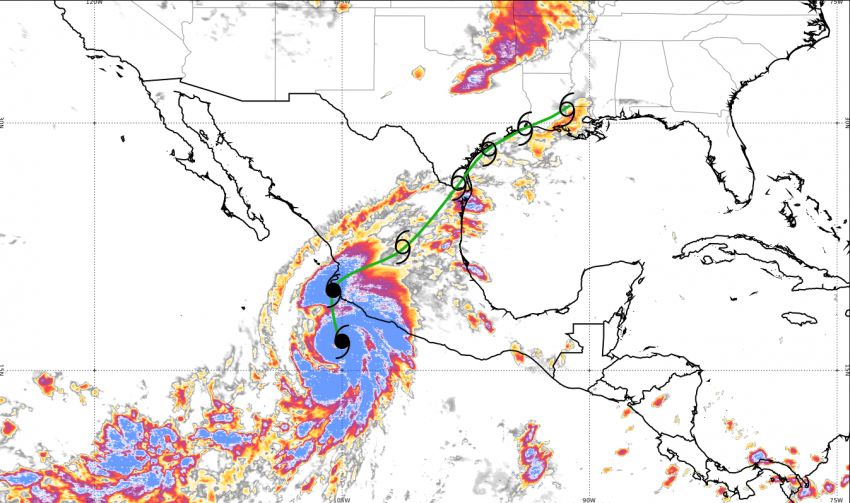
With a minimum central pressure of 878.4 mb, Hurricane Patricia will go into the record books as the most intense storm ever recorded in the Western Hemisphere. It is only the second time that such a powerful storm has struck the Mexican Pacific coast. The last time this happened was in 1959, when almost 2000 people perished in a devastating category 5 hurricane.
Read full article

Catastrophic Flooding In South Carolina

The tranquil pattern that dominated U.S. weather through the Fall was broken abruptly during the first week of October by a catastrophic flood event in the Southeast, South Carolina being the hardest hit. Like many extreme weather events, it can be blamed on a highly improbable combination of separate meteorological factors, any one of which by itself probably wouldn’t have been noteworthy at all.

Read full article

Meteorological Conditions Leading to Guatemala Landslide

On Thursday, October 1, a devastating landslide impacted the village of Santa Catarina Pinula, Guatemala. The small suburb of Guatemala City has been virtually wiped off the map and is now uninhabitable. Current estimations show that hundreds of people have died or are still missing. As rescue crews continue searching through rubble to find any survivors, many continue to question why such a community was allowed to be built in a vulnerable location. Unfortunately, Guatemala has a history of experiencing deadly landslides as there have been four in the last fifteen years, mainly towards the end of the rainy season.

Read full article