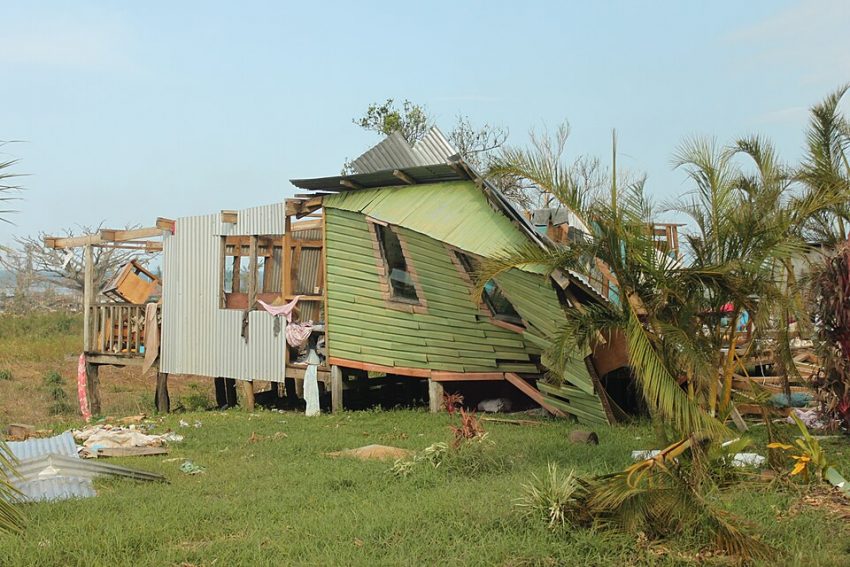
Bavi passed directly over the island of Rota, a U.S. possession about 40 miles (65 km) northeast of Guam, on Monday morning local time. At the time Bavi boasted sustained winds of 180 mph (290 kph), putting it well into “Super Typhoon” status. It’s only the sixth time in US history that a storm of that category or equivalent has made a direct landfall on U.S. territory. Residents of all the Northern Marianas from Guam up to Saipan and Tinian were urged to take extreme life-saving precautions. In addition to the destructive winds, a deadly storm surge and waves of more than 20 feet (6 m) were forecasted. Officials on Guam reported that emergency evacuation centers were already straining capacity on Sunday afternoon. Typhoon Sinlaku, of similar track and magnitude in April, caused over $1.5 billion worth of damage in these islands along with a death toll of 17. Some residents are still without power more than two months later.
WATCH: The office of Rota Mayor Aubrey Hocog has been destroyed by Super Typhoon #Bavi.
🎥: Kandit News Group pic.twitter.com/7RnK74iLR4— Scott (@RandomHeroWX) July 6, 2026
CATASTROPHIC winds are now impacting the island of Rota.
Remain sheltered even as the eye passes, conditions will rapidly deteriorate again as the backside of Typhoon Bavi moves through, bringing another round of LIFE-THREATENING winds.
Lets pray for Rota 🙏 pic.twitter.com/sz3vqK0Jx8
— MayaRisser (@MayaRiser) July 5, 2026
WATCH: Flooding in Hagatna, Guam as Super Typhoon #Bavi passed to the north.
🎥: Ray Gibson pic.twitter.com/JNCv5v6Dwm— Scott (@RandomHeroWX) July 6, 2026
Officials announced that they will begin damage assessments in earnest this (Tuesday) morning as Bavi continues to pull steadily away to the west. But the mayor of Rota has already reported major damage, including the almost total destruction of his own office (see video above). Officials in Guam report that almost a third of the island’s water wells are offline. Wind gusts at the airport in Saipan exceeded 100 mph (160 kph) during the height of the storm with numerous power outages reported. Bavi is expected to gradually weaken but threaten Taiwan and Japan’s Ryukyu islands late this week.