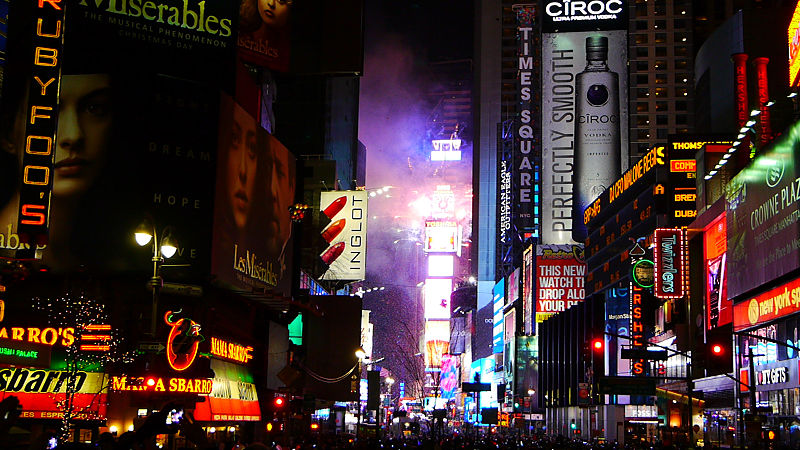
In the next few days people around the world will gear up for the holiday season’s last hurrah, the turning of the old year to the new. Fireworks aficionados in particular can look forward to the biggest shows of the year lighting up skies above many of the world’s major metropolises. But how well will Mother Nature cooperate?
The meteorological history of New Year’s celebrations in Times Square, New York is on the whole a fairly unspectacular one considering that New Year’s always falls in the heart of the winter season. On only a handful of occasions was there even light snow falling, although hearty partiers lining Broadway to watch the ball drop on December 31st, 1917 did so bundled up against wind chills down to minus 18°F (-28°C). This year a weak disturbance passing through the region will produce a few scattered rain showers threatening the early risers that start to populate the Square around midday on New Year’s Eve, however skies should clear out by evening. Temperatures will be cool but not frigid, near 50°F (10°C) during the day cooling to around 38-40°F (4°C) by midnight, probably a bit warmer than the historical average midnight reading of 33.7°F (0.9°C). Winds will be out of the west at around 10 mph (16 km/h) or less, not contributing much in the way of a wind chill, especially after the crowds fill in. Those who do arrive early hoping to grab their fifteen minutes of fame awkwardly making out on national TV later in the night will need to dress warmly for the twelve-hour wait with layers, gloves, and hats (as tall and colorful as you can find if you want the cameras to find you). Bring snacks and a hot drink, too, but pace yourself – public bathrooms are notoriously hard to come by around Times Square on New Year’s Eve.
The major city that can boast the earliest internationally renowned New Year’s party, a full sixteen hours ahead of the ball drop in New York, is Sydney, Australia. New Year’s Eve falls in the height of the Australian summer, so crowds there usually enjoy mild weather for watching the twelve-minute show (pictured above) featuring pyrotechnics firing from the iconic Sydney Opera House, the Harbour Bridge, and seven huge barges on the water. This year will be no exception with temperatures likely to be 68-70°F (20-21°C) at midnight with few clouds and light winds. Expect cooler conditions in London, UK with midnight temperatures around 43-45° F (6-7°C) and the chance for a few rain showers dampening spectators for the fireworks show there, tickets for which have been sold out since October. Up to two million people will crowd onto beaches like the Copacabana in Rio De Janeiro, Brazil to see the huge fireworks display there, just three hours before the New Year in Times Square. Temperatures will still be around 81-83°F (27-28°C) with a humid onshore breeze at midnight, however skies should be partly cloudy with a low chance for rain. Keep up with the latest New Year’s forecast details for these and other cities around the globe using the MORECAST app!